
Cross-Validate Competitor Backlinks: Find Domains Multiple New Sites Already Use
By LincSpider Team · 2026-07-25 · 11 min

Cross validate competitor backlinks and you stop guessing which referring domains are worth your Tuesday afternoon. Suite reports like Ahrefs Link Intersect or Semrush Backlink Gap are useful shortcuts — they show domains that link to rivals but not you. This guide goes one step further: export many newer winners in your niche, count how often each referring domain appears across those exports, and rank by co-occurrence.
That pattern finds platforms multiple successful new sites already used — usually easier to publish on and more likely to get crawled than one-off spam blogs. It pairs cleanly with Expand Backlinks from Competitor Link Pages (filter blogs and comments) and How to Find Blog Comment Backlink Opportunities. LincSpider handles the Chrome execution layer after research. It is not an Ahrefs replacement.
What Cross-Validation Means (and How It Differs From Link Intersect)
Cross-validating competitor backlinks means:
- Collect backlink exports from many peer sites in your space.
- Normalize each row to a root referring domain (not full URL paths).
- Count how many different peer exports mention that domain.
- Sort descending — domains at the top appeared on the most independent “homework.”
Ahrefs Link Intersect and Semrush Backlink Gap do a version of this inside the product: domains linking to several competitors but not you. Backlynk’s gap write-up calls “links to all three competitors” the highest-conviction filter. Same idea.
The CSV cross-validation pass adds:
- Bigger sample sizes (20+ domains, not just three in the UI).
- Mixing exports from Bing, trial suites, or cheap checkers — then reconciling in a sheet.
- A focus on recently successful sites, where links are mostly deliberate, not decades of random mentions.
On r/SEO:
I want to analyze his competitors' backlink profiles and then reach out to the websites they already get links from.
Fair first step. Cross-validation is how you prioritize that list when it is thousands of rows deep.
Why Newer Winners Beat Old Incumbents as Copy Targets
Copying a Fortune-500 brand’s backlink CSV sounds smart until you open it. Old incumbents mix editorial links, acquisitions, charity pages, and twenty years of noise. High-traffic sites that grew in the last one to two years usually show cleaner, operator-built patterns — directories they submitted to, blogs they commented on, tool lists they joined.
Verticals with explosive niches (games, AI tools, calculators) can produce enormous backlink counts. You will not hand-copy every row. Cross-validation turns “infinite homework” into a sorted queue: work the top of the list first.
On r/SEO, an auditor noticed a profile full of only “power” magazines and news sites — good links, but missing smaller web properties competitors also used. Newer peers often reveal those mid-tier, replicable hosts.
Build Your Competitor Sample List (Aim for 20+ Domains)
You need breadth before math helps.
Step 1: Pick the keyword set
Choose buyer-intent and category terms you actually want to rank for — not vanity volume. One SaaS might track “invoice reminder app,” “freelancer billing tool,” and “stripe invoice automation.”
Step 2: Record SERP leaders
For each term, Google the query and note domains in the top ~10 organic results. Skip obvious aggregators you will never mimic. Keep sites in your language and business model.
Step 3: Repeat across products
Do the same for adjacent products in the niche. After a few rounds you should have 20+ unique domains — more is better. Co-occurrence counts get stabler with sample size.
Step 4: Tag “new winner” vs “incumbent”
Prefer domains that visibly grew recently (traffic step-change, fresh product launches, young blogs ranking fast). Keep a few incumbents for contrast, not as the main copy pool.
Indie Hackers frames the research spine well:
Studying top-ranking competitors. Identifying websites linking to those competitors.
Cross-validation is the scoring layer on top of that identification step.
Export Active Referring Domains (Not Just Homepage Links)
For each sample domain, pull referring domains or referring pages from whatever tool you have:
| Source | What you get | Cost |
|---|---|---|
| Bing Webmaster Tools | Referring domains for domains Bing knows | Free |
| Ahrefs / Semrush / Moz | Active backlinks, filters, CSV export | Paid / trial |
| Free checkers | Samples — fine for learning, thin for bulk | Free |
Export settings that matter:
- Active links only (drop dead domains).
- Prefer dofollow if the tool lets you filter; otherwise filter in the sheet.
- Export referring domain column when available — saves you from parsing URLs.
On r/SEO, practitioners debate Semrush Backlink Gap vs Moz Intersect vs Majestic Clique Hunter. Same thread, wiser reply:
Because backlink profiles in all 4 tools you've mentioned very loosely correlate with each other… and with Google's backlink index.
Treat every export as a sample, not ground truth. Cross-validation across many exports beats arguing which suite is “most accurate.”
Export limits are real
Built-in Intersect views cap rows. On r/SEO:
Link Explorer's Intersect from Moz exports the top URL that links to each competitor, but only lets it export the first 500 rows
CSV merging sidesteps per-report caps — another reason to export per competitor and merge yourself.
Run the Cross-Validation Pass
This is the core algorithm. Plain English:
- Normalize each row to root domain (
news.example.com→example.com). Use consistent rules (stripwww., lowercase). - Tag which competitor export each row came from.
- Count unique competitor exports per referring domain.
- Sort by count descending.
Sheet method (no code)
| referring_domain | appears_in_exports | example_hosts |
|---|---|---|
tooldir.com | 14 | site-a, site-c, site-f… |
nicheblog.net | 9 | … |
appears_in_exports is your co-occurrence score.
Script method
A short Python or Apps Script job that reads a folder of CSVs and prints sorted counts is enough. Coding agents can draft it in minutes. Keep the script dumb: domain extract → counter → CSV out.
Shortcut when tools already export referring domains
If your CSV has a clean Referring domain field, skip URL parsing. Fewer bugs, faster day.
Read the Ranked List Honestly
High co-occurrence usually means:
- The platform accepts sites like yours (multiple operators succeeded).
- Links there often get indexed (otherwise peers would stop using it).
- The domain is ** niche-relevant** enough to show up across independent homework.
It does not mean:
- You should auto-post everywhere tomorrow.
- Every top row is a blog comment (many will be directories or guest posts).
- Google owes you rankings.
Still open the page and vet — same five-minute habit as competitor expansion. WebmasterWorld keeps the tone grounded:
You want quality backlinks, the more the better, but no two links will have precisely the same effect so don't drive yourself crazy trying to predict things in too much detail.
Cross-validation shrinks the search space. Judgment still picks the final queue.
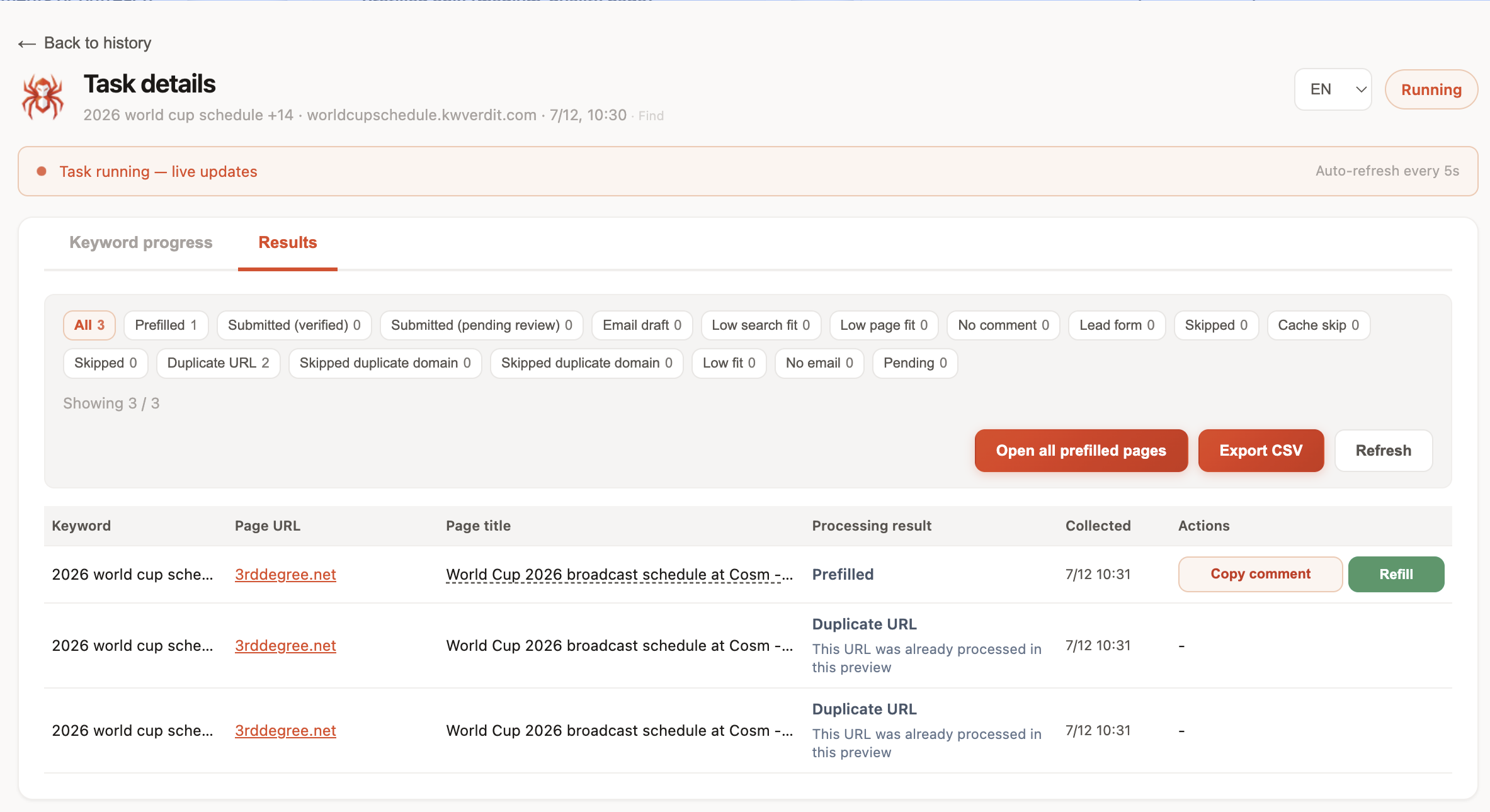
What “good” co-occurrence looks like in practice
In tool and SaaS niches, the top of a cross-validated list is often curated directories and “best tools” hubs — boring, unglamorous, and exactly what multiple new sites used first. That alignment with industry common sense is a sanity check that your counting logic works.
Operators report finishing a day of exports + cross-validation with thousands of candidate domains, then hitting a new bottleneck: actually publishing links with human quality control. That is a healthier problem than “nowhere to start.”
Budget Paths: Free, Trial, and Paid
You do not need a permanent $129/mo subscription to run this once.
On r/SEO:
Depending on a lot of factors, you can actually go incredibly far using only free tools and / or trial version of tools.
On r/SEO, operators buy a one-week Ahrefs trial, bulk-export competitor profiles, then cancel. Ethical? That is your call with the vendor’s terms. Practical? Common.
Combine:
- Bing exports for a baseline.
- One trial week for dense CSVs.
- Affordable link building tools for spot checks.
Then merge everything into one cross-validation folder.
After the List: Semi-Automated Outreach (Not Auto-Spam)
Fully automated link blasting needs custom captcha and moderation bypass — high risk, low skill ceiling. Semi-automation is the sustainable pattern:
| Channel | Semi-auto pattern |
|---|---|
| Blog comment | Read page → AI drafts contextual comment → you paste/submit |
| Tool directory | AI writes blurb → extension prefills form → you review/submit |
| No form | Short personalized email → you send |
Never unattended mass posting. Google’s link spam policies still apply. So do moderators.
For audit → queue workflows, see From Free Backlink Audit to Outreach Targets.
Where LincSpider Fits After You Have a Ranked List
Research suites and spreadsheets answer where to show up. LincSpider helps you work the page in Chrome after cross-validation:
| Element | Detail |
|---|---|
| Value | Discover related pages from seeds, draft contextual comments or emails, prefill forms — you confirm every submit |
| Who | Indie founders, solo SEOs, small growth teams who already have a vetted domain list |
| When | After co-occurrence ranking and manual vet — not instead of cross-validation |
| Install | Chrome extension download · credits on /en/pricing |
| Flow | Install → open a vetted URL → generate draft → prefill comment or email → you submit manually |
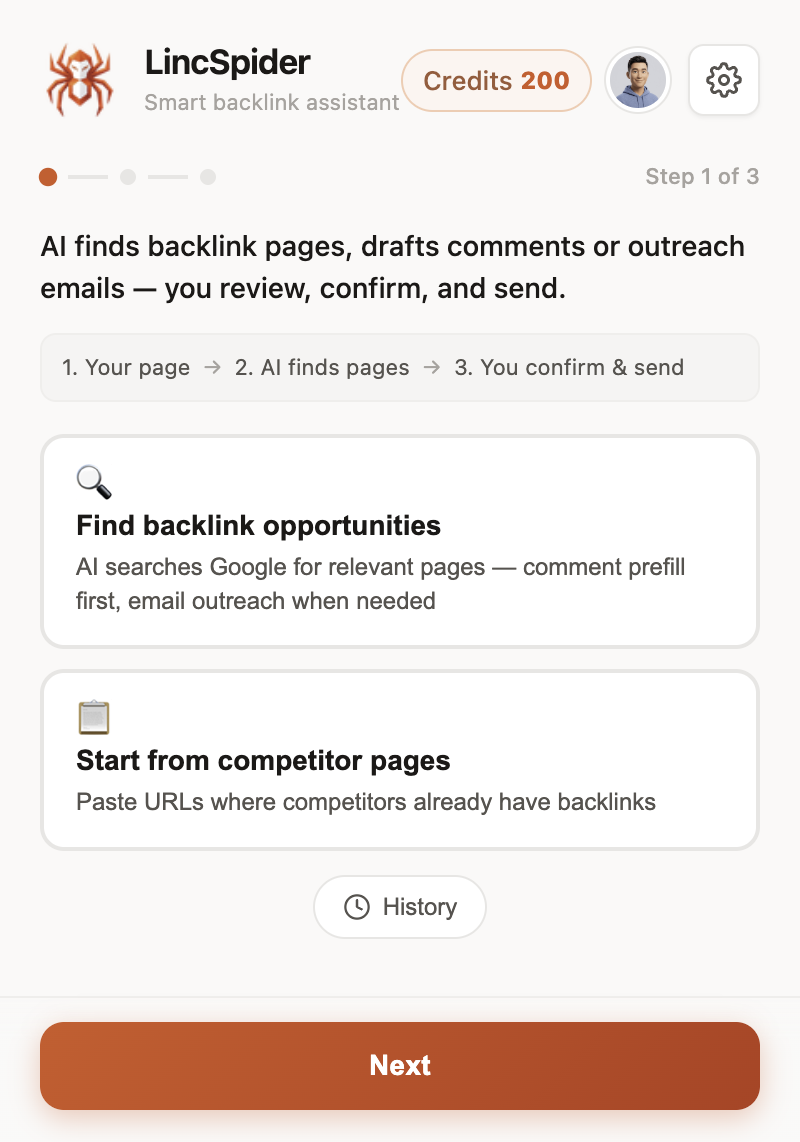
LincSpider does not replace Semrush/Ahrefs exports, does not auto-post, and does not guarantee indexing. It reduces friction on the execution you already decided to do. Deeper product walkthrough: LincSpider Chrome Extension Guide.
FAQ
What is cross-validating competitor backlinks?
Exporting backlink data from many peer sites, counting shared referring domains, and ranking by how many independent exports mention each domain — so you prioritize hosts multiple successful sites already used.
How is this different from Ahrefs Link Intersect?
Intersect compares a small set of domains inside Ahrefs. CSV cross-validation scales sample size, mixes tool sources, and emphasizes newer winners in the niche.
Why focus on newer sites?
Their links are mostly deliberate growth work, not decades of random mentions — cleaner homework to copy.
How many competitor domains do I need?
Roughly 20+ in the same niche for stable co-occurrence signals. More is better until returns flatten.
Does high co-occurrence guarantee a good link?
No. It raises confidence that the platform is publishable and often indexed. You still vet each URL.
Can I do this without paid SEO tools?
Yes — Bing plus manual exports and a sheet works. Paid trials help for bulk CSVs; see affordable tools.
Where does LincSpider fit?
After research: Chrome discovery, drafts, and prefill with human approval — start at /en/download.
Wrapping up
Cross validate competitor backlinks by merging many new-site exports, counting shared referring domains, and working the top of the list with real judgment. Suite intersect reports are a head start; co-occurrence ranking is how you scale the sample without drowning in rows. Pair the list with competitor expansion filters, vet like a moderator, then run outreach in the browser with LincSpider when you are ready to execute.